Hydronic snow-melt · Park City · Deer Valley · Heber · Wasatch Back

The boiler and the loop, designed together.

Most snow-melt failures we get called to fix come from one of two design mistakes — a boiler sized only for home heat that bogs down during a storm, or sensor logic that doesn't account for altitude and Utah's freeze-thaw cycles. We're hydronic specialists. We design the heat source and the snow-melt loop as one system. That's what every electric-only installer and HVAC generalist can't.

Coverage area: Park City · Deer Valley · Heber · Midway · Cottonwood bench Typical install: $14–$22/sq ft Project range: $20K–$80K System life: PEX 50+ yr
Why this matters

Three categories of installer. One that actually integrates.

Snow-melt isn't a standalone product. It's a hydronic system that needs the same boiler-loop-control design discipline as your radiant heat. Here's how the market splits.

Electric-only installers

Cheap on small jobs, but operating cost is 3–5x higher than hydronic across a Utah winter. For an average Park City driveway running 75 storm-events per winter, electric will burn $1,200–$2,100 per season vs $420–$560 for hydronic. Compounding gap. Also: electric heating mats have ~15–25 year service life vs 50+ years for PEX tubing in concrete. The job needs to be re-done within a generation.

HVAC generalists (heat-pump and furnace shops)

Sometimes offer snow-melt as a side service, usually subcontracting the loop install to a plumber and supplying their own boiler. The result: a boiler picked from their preferred lineup that may or may not be ideal for a snow-melt application, and a loop installer who doesn't communicate with the heat-source designer. We get called to retrofit these systems regularly because the integration failures only show up in deep winter.

Hydronic specialists (us)

We design the system as one integrated piece. Heat-loss calculation for the home, snow-melt BTU load based on driveway area and your specific elevation/exposure, boiler sized to handle both at design conditions, glycol mix tuned for your altitude, sensors and controls set up for the way you actually use the driveway. End-to-end accountability — same team, same plans, same warranty. That's the entire pitch.

Recent projects

What "designed together" actually looks like.

Real installs from this year. The pre-pour photos show why retrofit is harder than new construction.

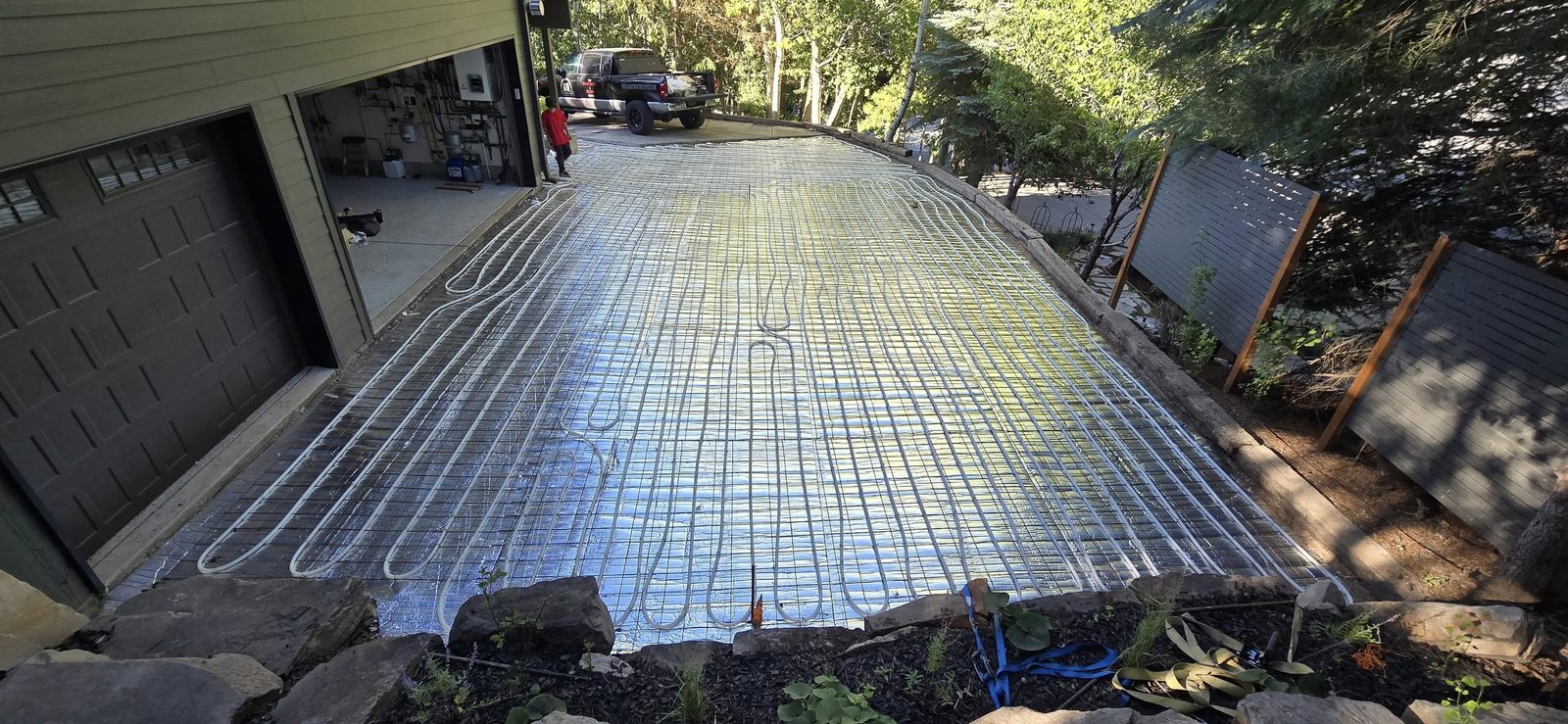
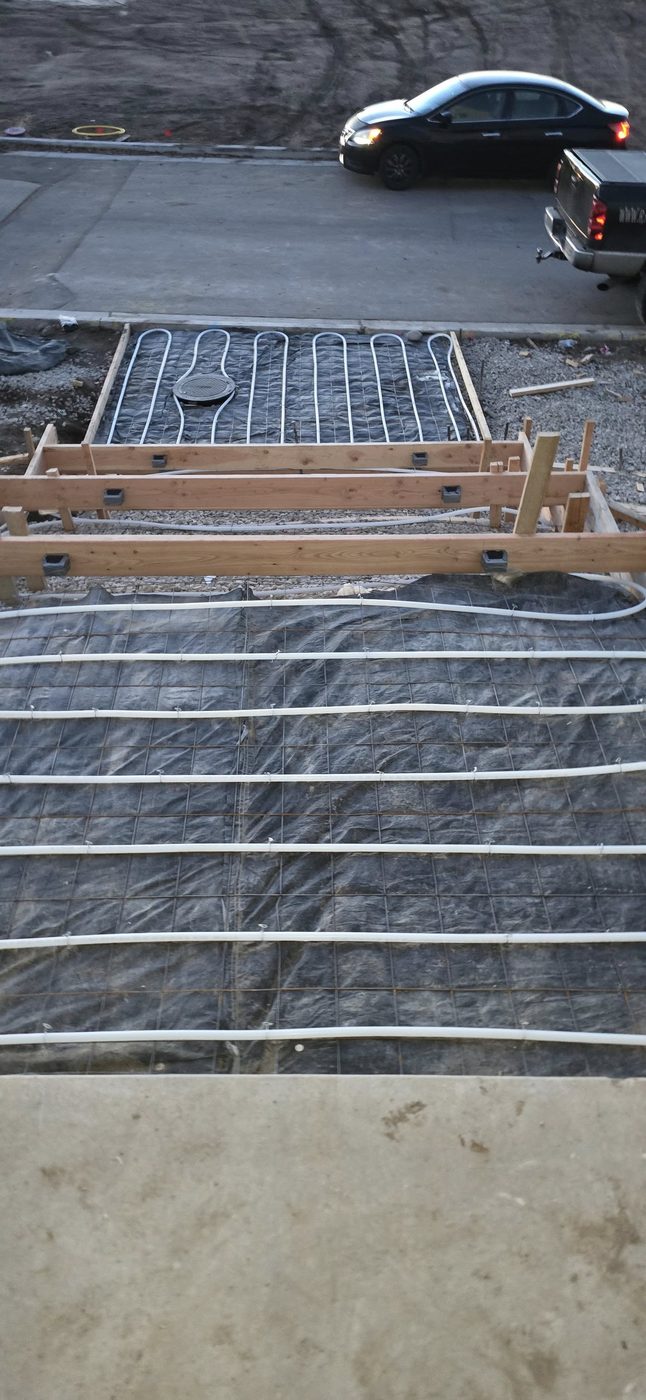
Snow-melt PEX tubing tied to rebar grid before concrete pour at a Park City residential install
Pre-pour, Park City PEX-A tubing tied to rebar at 9" on-center spacing. Manifold supplies on the right; loops returned for pressure-test before pour.
Completed hydronic snow-melt driveway in Utah, ready for use
Commissioned install, Wasatch Back Smart-sensor controls, 45% glycol mix for altitude, tied to existing Lochinvar Knight boiler with spare capacity.

The design discipline that separates a system that works from one that doesn't

Boiler sizing for combined load

This is where most generalist installs fail. Your home's boiler was sized for home heating. If you add a snow-melt loop without verifying combined-load capacity, the worst-case winter storm overlaps with your coldest heating night and the boiler can't keep up. We run a combined heat-loss calculation: home BTU/hr at design temperature + snow-melt BTU/hr at design snow rate. If the existing unit has spare capacity, we tie in. If not, we add a dedicated snow-melt boiler. We don't guess.

Altitude commissioning

At Park City (7,000 ft) and Deer Valley (8,000+ ft), atmospheric pressure drops roughly 22–27% from sea level. Factory-tuned condensing boilers run rich at altitude, foul flame rods, and lose efficiency. Manufacturer altitude tables specify the orifice and combustion adjustments needed. Most generalist installers skip this. We commission every install above 5,500 ft to the table.

Glycol mix calibration

Snow-melt loops use propylene glycol (food-safe, in case of pipe rupture). The mix percentage trades off freeze protection against heat-transfer efficiency. Too lean — freeze risk. Too rich — system efficiency drops 8–15%. Utah's design temperatures vary by elevation: 30% at Cottonwood Heights bench, 40% at Park City, 45–50% at Deer Valley. We pull from your specific elevation's design temp.

Sensor and control strategy

Two control approaches, and they differ by 3–5x in operating cost over a winter.

  • Smart pavement sensor: a sensor at the slab surface fires the loop only when there's actual precipitation hitting the surface at freezing-point conditions. Gas bill impact $280–$680 per winter. This is what we install by default.
  • Idle mode: keeps the slab at just above freezing all winter regardless. Melts snow faster on contact but runs continuously. Bills $1,200–$2,400 per winter. We retrofit these to smart controls regularly — the savings pay back the retrofit cost in one or two seasons.

Manifold layout and loop spacing

Loop length and tubing spacing determine even melt across the slab. Loops over 300 ft develop unbalanced flow; we keep loops under that limit. Spacing varies by area exposure: 9" on-center for high-traffic driveways, 12" for walkways. Manifolds are placed for access — not buried in a wall where the next service tech can't reach them.

Freeze-thaw concrete protection

A real concern in Utah specifically. Freeze-thaw cycles damage concrete over years; snow-melt protects against this by keeping the slab above freezing through the cycle window. But poorly designed snow-melt makes it worse — repeated heating of a concrete surface that then re-freezes accelerates surface scaling and cracking.

The design rule: once the system fires, it runs until the slab is fully dry. Smart sensors handle this automatically. Manual or basic timer-controlled systems don't, and the homeowner can't catch every cycle. This is one of the biggest reasons we won't install snow-melt without proper smart controls.

Snow-melt cost in Utah: what each variable does

For a typical 1,000–1,200 sq ft Park City or Wasatch Back driveway:

  • New construction (poured with the slab): $14–$18/sq ft. $14,000–$21,600 for a typical driveway.
  • Retrofit with full driveway replacement: $18–$22/sq ft, including pavement removal and re-pour. $18,000–$26,400.
  • Retrofit via saw-cut (rarely recommended for residential): $22–$28/sq ft.

The above includes tubing, manifolds, controls, sensors, and boiler tie-in if the existing boiler has spare capacity. Add a dedicated snow-melt boiler if needed: $4,500–$8,000 incremental.

The full project budget for a Park City or Deer Valley custom-home driveway typically lands $20,000–$80,000. The high end of that range covers large driveways (2,000+ sq ft), multi-zone systems (driveway + walkway + steps), dedicated boilers, and premium controls.

For full pricing context across our hydronic services, see our snow-melt ROI guide and radiant floor cost guide.

Request a consultation

Free on-site design consultation.

Tell us about the project. We'll come out, measure, walk through your goals, and follow up with a written design proposal and quote. No charge, no obligation.

Request received. We'll follow up within 1 business day. For urgent service, call (801) 685-3976.

We typically respond within 1 business day. For urgent service, call (801) 685-3976.

Frequently asked questions

For a typical Park City or Wasatch Back driveway (1,000–1,200 sq ft) installed during a new pour: $14,000–$22,000. Retrofit with full pavement replacement: $21,000–$28,000. Variables that move the number: pavement area, whether you have an existing boiler with spare capacity, sensor strategy, and complexity of the manifold layout.
For driveways and substantial areas, hydronic wins on operating cost (3–5x cheaper than electric) and lifespan (50+ year PEX vs 15–25 year electric mat). For very small areas — single steps, a short walkway — electric is simpler. Anything bigger than ~300 sq ft, hydronic almost always makes sense in Utah's heavy-storm climate.
Often yes. A typical modern mod-con boiler in the 120,000–199,000 BTU range can support roughly 1,000–1,400 sq ft of snow-melt in addition to home heating — if it has spare capacity at design conditions. We run a combined heat-loss + snow-melt load calculation to verify. If the existing boiler can't take the additional load, we add a dedicated snow-melt boiler ($4,500–$8,000 incremental).
For new construction or full driveway replacement: lock the design consultation by July, schedule the pour and tube install by August, commission the system by mid-October. Retrofit installs that don't require a repour can sometimes be done in November, but parts of the work become weather-dependent. We don't recommend cutting it that close.
Most snow-melt failures we get called to fix come from one of two design mistakes: a boiler sized only for home heating that gets overwhelmed by simultaneous snow-melt + heat demand, or sensor and control logic that doesn't account for altitude and Utah's freeze-thaw cycles. We design the boiler and the loop together as one system. Generalists often subcontract one piece or the other, which is where the integration failures happen.
At 7,000+ ft, atmospheric pressure is about 22% lower than at sea level. That affects boiler combustion (must be properly derated), glycol mix (typically 40-50% to handle deep freezes), and expansion calculations for the loop. We commission every install above 5,500 ft to manufacturer altitude tables.
Related services

Pairs with the rest of the hydronic stack.

Snow-melt rarely lives alone. The boiler and the radiant system are part of the same conversation.

Ready when you are

Snow falls. The driveway stays clear.

Free design consultation. On-site visit, written proposal, no commitment.

📞Call (801) 685-3976